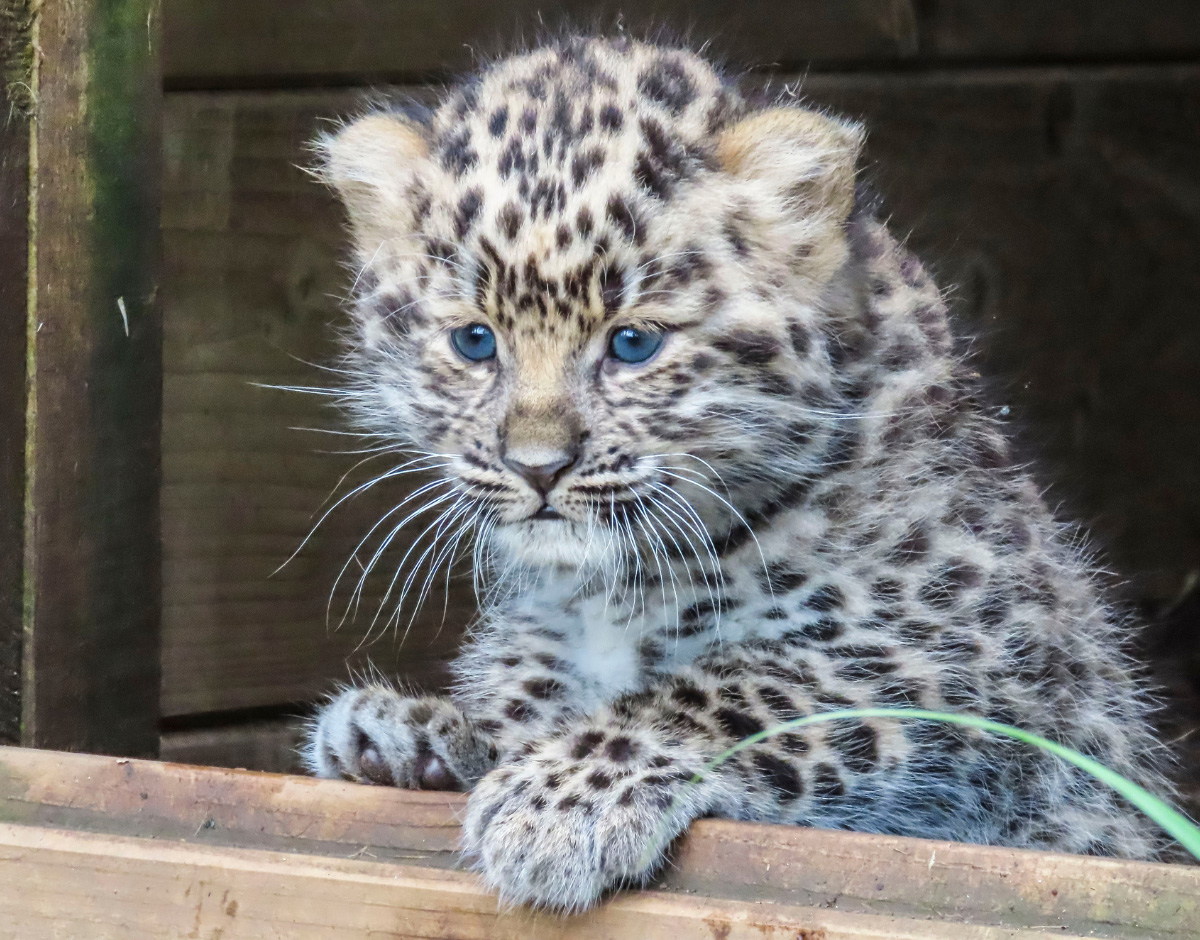
Dartmoor Zoo are thrilled to announce their Amur Leopard Cub has been identified as a female and the keeper team have selected her new name. Introducing, ‘Zeya’.
On Monday 29th September, Dartmoor Zoo were thrilled to witness that their breeding pair of Amur Leopards, Freddo and Lena, successfully brought a beautiful new cub into the world. Staff were able to observe the birth via CCTV footage of the cub and mother in their cubbing den. Less than 5 weeks later the cub began to explore its surroundings and now 10 weeks on there’s confirmation of a sex and name to celebrate – a female named Zeya. One of only 15 Amur Leopards born globally in 2025, this is a huge milestone not only for Dartmoor Zoo, but for global conservation efforts of the Critically Endangered, Amur Leopard species.
Zeya is named after the River Zeya, a major northern tributary of the Amur River, within the Amur Leopard’s native region. The naming honour was undertaken by the Dartmoor Zoo, keeper team, who all pitched together to come up with a selection of names, relevant to the Amur Leopard’s natural habitat in the wild before ultimately choosing their favourite.
CEO David Gibson commented: “With fewer than 200 of the species in captivity globally, the birth of our Amur Leopard cub at the end of September this year is a fabulous achievement for Dartmoor Zoo and for the global conservation efforts for Amur Leopard. Now that we know for definite that the cub is healthy and thriving, we can allow ourselves to properly celebrate this major event. Watching how Lena has cared for this precious soul in the first few weeks of its life is a real privilege and one that all the staff at zoo have enjoyed. We now want to work on getting both Mum and cub on show so our guests can also enjoy this amazing news.
In terms of the global conservation breeding programme the fact that our newest arrival is a female is crucial as in the years to come she will go on to give birth to her own cubs helping to safeguard the future of this critically endangered species.”
Amur Leopards are regarded as the world’s rarest Big Cat with only an estimated 120 left in the wild. This number has been slowly increasing in recent years due mainly to improved legal protection and enforcement in their range countries. For this reason, the IUCN categorises the Amur Leopard as being Critically Endangered.
Although it is not currently possible to consider re-introductions of animals into the wild, maintaining a healthy growing population of Amur Leopards within the world’s zoos is essential to ensuring the continuing recovery of this enigmatic and highly secretive predator.
The Amur Leopard is one of 9 species of Leopards known to mankind. In the wild its principal prey is the Sika Deer which it hunts on densely forested valleys and mountain sides.
Amur Leopards are a cold adapted species meaning they can survive in the most challenging of conditions. Their thick coat allows them to stay active and hunt throughout the worst of the winter in the extreme North Eastern China and South Eastern Russia.
Keeper Hannah Ivory commented: “Zeya is a full of beans little girl, who loves nothing more than playing with mum’s tail and testing her strength climbing the platforms. We often joke she’s a spider-cat as even at 10 weeks, she’s already a very good climber!
Lena and Zeya have a very close bond already and they are now starting to explore the challenges of weaning, as Lena is very food motivated and is having to learn to share with a little mouth. Zeya has identified rabbit as her favourite so far and has been brave enough to tong feed from keepers. She has a feisty personality just like her mum and has stolen the hearts of everyone who has met her!
Freddo has been keeping a close eye on them both and has been seen interacting and trying to play with his young daughter through the slides. We are hopeful that all continues to go well and she grows nice and strong before we move them into the on-show enclosure for her next adventure.”
Zeya and Lena are currently still off show to the public, ensuring Zeya has ample time to continue thriving and to undergo initial health checks. Announcements of when the public can view our newest family member will be made in due course.
If you are able and willing, please donate towards more conservation projects like this, to help Dartmoor Zoo keep up the good fight!
To find out more about Dartmoor Zoo visit www.dartmoorzoo.org.uk.