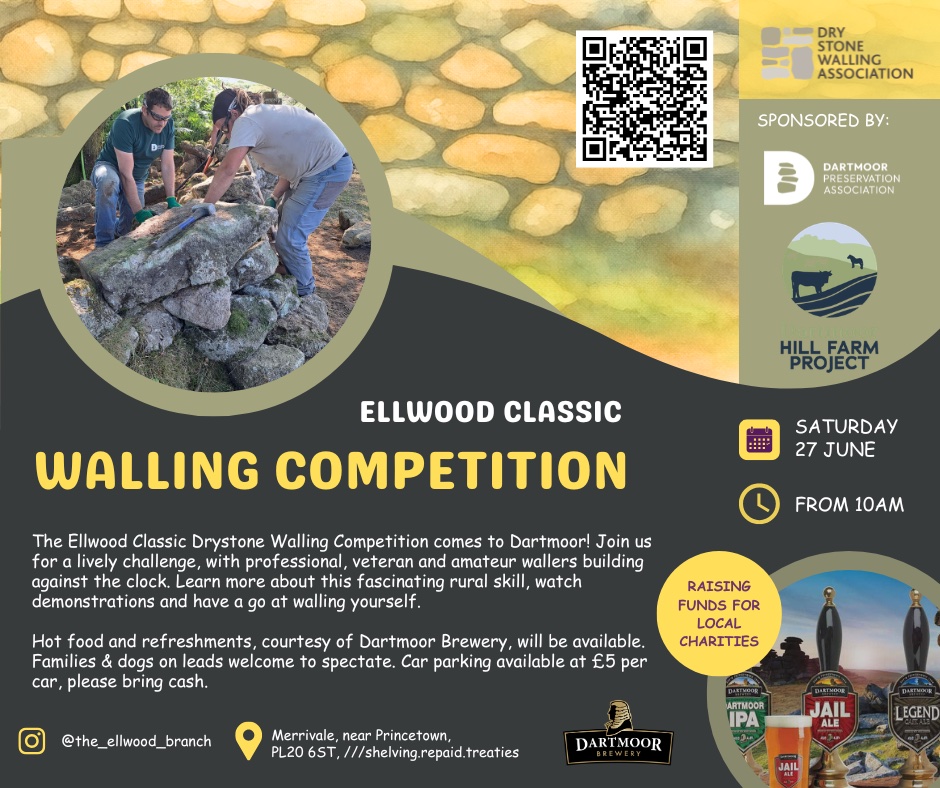
The Ellwood Classic Walling Competition comes to Merrivale on Saturday 27th June 2026. The Dartmoor Preservation Association is sponsoring the event, with generous support from Dartmoor Hill Farm Project, Dartmoor Brewery and the Dartmoor National Park Authority.
Says the DPA, ‘It’s fantastic to have the opportunity to host this prestigious competition on Dartmoor, with both local and visiting wallers from across to country competing against the clock. Walling is an important rural skill which has contributed so much to the character of Dartmoor and it deserves to be celebrated and passed on to new generations.’
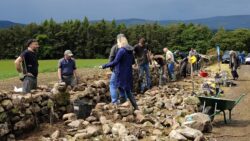
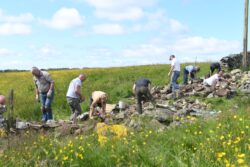
Competing wallers will be onsite from the Friday to the Sunday, with spectators invited from 10am on the Saturday to view how the teams are progressing. Categories include: Professionals, Professional Pairs, Amateurs and Veteran wallers.
Hands on Opportunities for Spectators
On the Saturday, spectators will have the chance to watch walling demonstrations and have a go at walling themselves, plus learn more about the history and modern day importance of this fascinating rural skill. There will also be history walks, sheepdog demonstrations and a pop up cake stand provided by volunteers from Sampford Spiney Church. Hot food will be available to purchase onsite and refreshments, courtesy of Dartmoor Brewery, will be for sale. Families and dogs on leads are very welcome, with on-site parking at Merrivale provided at the cost of £5 cash per car. Entry to the event itself is free.
The event on Dartmoor will be particularly challenging for the Ellwood Branch as the competition will be based on Devon Banks and not dry stone walls. A Devon Bank has an earth core and comprises of two separate stone facings bonded by soils and vegetation with a distinctive batter.
History of the Competition
The first Ellwood Classic was held on the 22nd of June 2019 in Cumbria, home of Ted Ellwood, the greatest competition waller ever, and who the Ellwood Branch are named after. The competition moves every year to try and be as inclusive as possible to all areas of the isle; much like the Branch itself.
Trophies are awarded for winners of the Professional, Amateur and Veteran classes. Ted also kindly donated an additional trophy for best work/wall on field just before he passed away. The competition was set up by professional wallers in Cumbria and Yorkshire and previous competitions have been held in Aberdeenshire and Northumberland, amongst others.
The Importance of Devon Banks and Drystone Walls on Dartmoor
There is evidence of drystone walling being used as far back as 3200BC and these types of walls are a familiar and recognizable sight on Dartmoor. They are used to mark field boundaries and keep animals in or out. There are many advantages of a drystone wall, compared to walls built with brick and mortar, and drystone walls are particularly suited to the conditions in remote areas of the moor. Because drystone walls are held up by gravity and friction, there is no mortar to break down and fail over time, which can happen quite quickly when exposed to repeated freeze and thaw cycles. Instead of gathering in any hollows, water runs straight through a drystone wall and is able to soak away into the ground.
Along with drystone walls Dartmoor is known for other boundary styles of which the Devon Bank is the most numerous. These can be made up of an earthen bank with a woody crown or a stone faced earth bank with trees and shrubs on top. Unlike a drystone wall the bank is held together by the inner core and the roots of vegetation and shrubs which help to bind the structure together. Stone facing often includes large ‘grounders’ or ‘shiners’ and smaller stones are then ‘pitched’ (upright) or coursed (horizontal) creating a ‘batter’ or profile.
The type and nature of the local stone dictates the form of construction and the bank is often associated with a ditch. Where the boundary abuts the common the outer face may be maintained with the inner ground formed by a slope creating a wedge shaped profile. Woody vegetation is dictated by elevation and the degree of soil in the core and this varies form wind pruned Hawthorn at higher levels to dense Hazel crowns in the valleys. As well as traditional practices for building and maintaining the bank there are also local traditions for hedge laying.
Applications to take part in the competition can be made by contacting the Ellwood Branch of the Dry Stone Walling Association via ellwoodbranch@gmail.com.
Find out more about the event at Ellwood Classic Drystone Walling Competition – Dartmoor Preservation Association